A clear file makes a better part.
Supply dimensions in millimetres, intended use and quantity. Reference images explain an idea; they do not replace a production file.
A brief feasibility check is free. Simple CAD with one prototype starts at AED 800.
Simple parts. Natural surfaces.
Examples of practical parts in the materials we offer. We confirm the geometry and finish from your file before production.
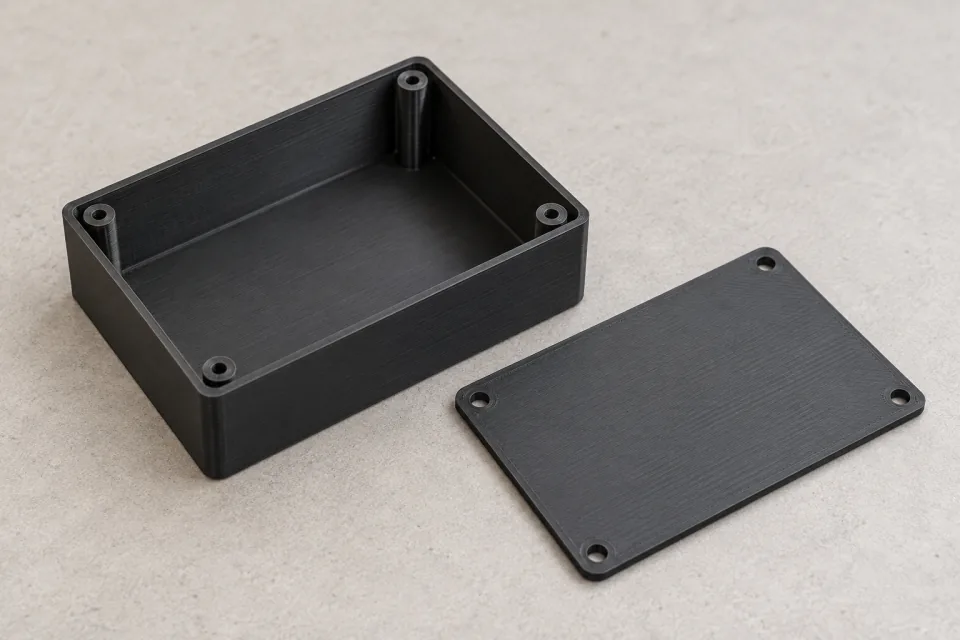
PETG enclosure with flat lid
Open enclosure and matching lid, with visible FDM layer lines.
Dimensions, material and finish are agreed before production.
Before you request a quote
Send the purpose, dimensions, quantity, date and production file. For one simple prototype, a sketch with dimensions is enough to start a review.
File guidelines ↗3D / CAD files
STL · STEP / STP · 3MF · OBJ
From AED 800: CAD for one simple part from your dimensions, one model correction before production, and one physical sample. Scope is fixed before work starts.
Laser / vector files
SVG · DXF · PDF · Adobe Illustrator
Up to 10 files, 25 MB each, 75 MB total. STL, STEP, 3MF, OBJ for print; SVG, DXF, vector PDF or Adobe Illustrator for laser. JPG/PNG sketches are accepted for simple prototypes. Image references alone do not qualify as ready production.
What are you making next?
Send a file or sketch on WhatsApp, with dimensions, quantity and your preferred date. We’ll help define the next step.
A brief feasibility check is free. Simple CAD with one prototype starts at AED 800.